
 Image 1 of 1
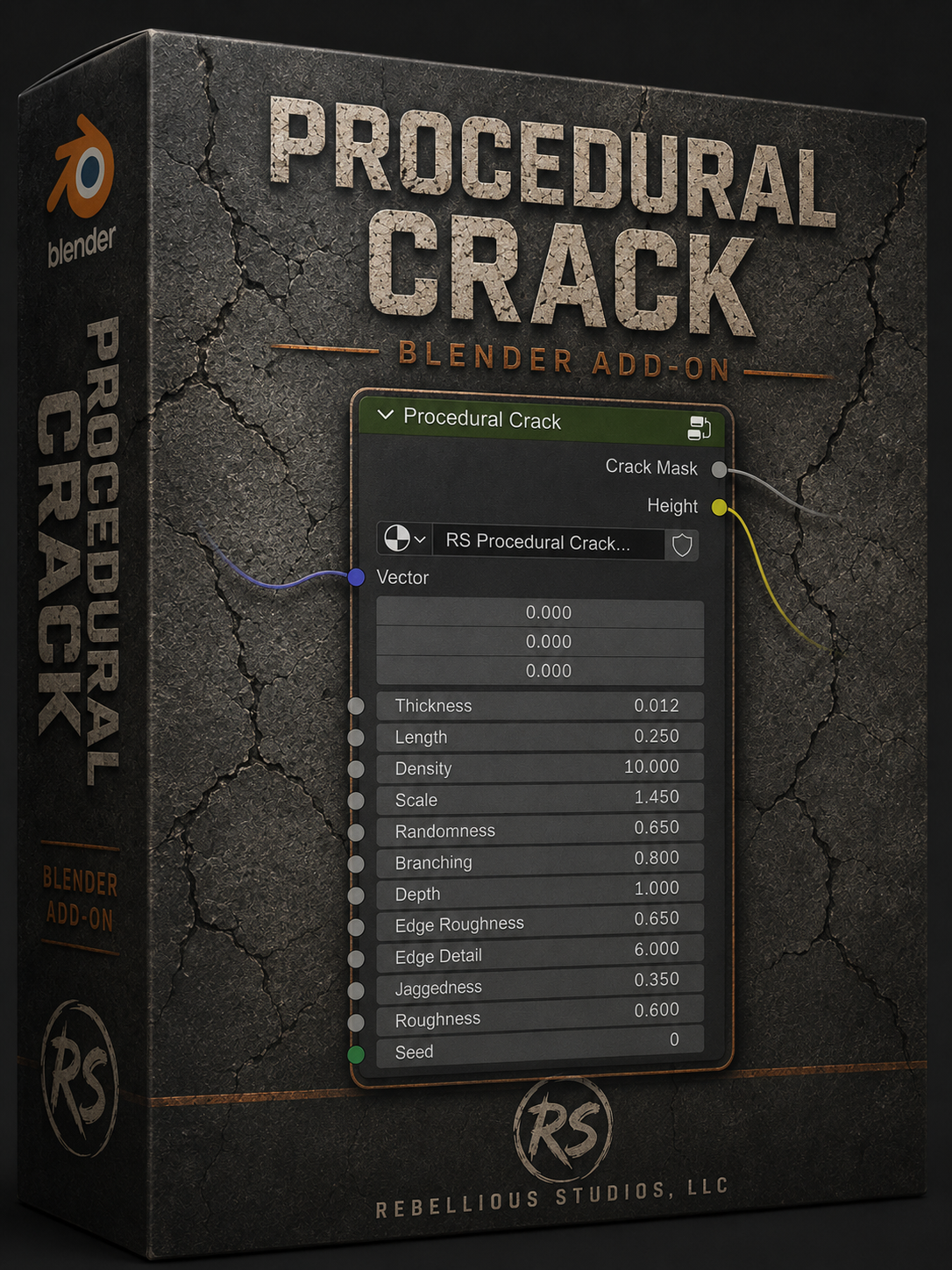
Procedural Crack
Sale Price:
$15.00
Original Price:
$25.00
Create cracks that belong to the material instead of looking pasted on top of it.

Procedural Crack generates detailed crack morphology entirely from native Blender shader nodes. Its two purpose-built generators cover both major families of surface failure: localized cracks that spread outward from an impact or stress point, and connected cellular networks formed by drying, shrinking, and widespread material breakup.

Every result remains adjustable. Control the overall scale and thickness, change the reach and density of impact networks, vary branching and direction, sharpen or erode the edges, introduce fine jagged detail, and reproduce a chosen result with a deterministic Seed. The supplied Crack Mask integrates with custom color, roughness, weathering, and material-layer workflows, while the separate Height output provides a stable source for recessed bump detail in Eevee and Cycles.

The generators were developed through direct visual comparison with real cracked mud, asphalt, concrete, masonry, and impact-fracture references. They are designed to produce convincing close-up detail while remaining flexible enough for walls, ground surfaces, architectural materials, environment art, and decal-authoring workflows.## Two Crack Generators

### Impact Network

Build localized, branching cracks that radiate from shared stress origins.

- Generate one or more complete crack events rather than unrelated line fragments.
- Control crack reach with Length and encourage natural intersections at larger values.
- Progressively introduce additional isolated crack events with Density.
- Adjust Branching from restrained main fissures to more developed fracture networks.
- Break up straight procedural paths with independently jagged centerlines and varied branch directions.
- Shape bold concrete fractures, wall damage, asphalt cracks, impact marks, and stress failures.

### Cellular Breakup

Create connected plate-like crack networks inspired by dried mud and fractured surface layers.

- Generate closed, irregular cells instead of a uniform grid of straight polygons.
- Combine large primary plates with smaller clustered micro-fractures.
- Add fine angular tributaries and sharp secondary cracks between larger divisions.
- Control edge breakup, jaggedness, surface roughness, and recessed depth.
- Produce dried-earth patterns, aged concrete, cracked paint foundations, asphalt breakup, and broad weathered surfaces.

## Feature Highlights

- Two specialized procedural generators: Impact Network and Cellular Breakup
- Fully procedural crack generation with no image textures required
- Deterministic Seed control for repeatable results
- Adjustable thickness, scale, depth, edge roughness, edge detail, and jaggedness
- Art-directable impact length, density, randomness, and branching
- Multiple complete impact events with natural overlap and intersection
- Irregular cellular plates with clustered secondary micro-cracking
- Clean Crack Mask output for color, roughness, layering, and decal workflows
- Dedicated Height output for recessed surface detail through an external Bump node
- Native Blender shader nodes with no OSL, Geometry Nodes, or runtime Python pixel evaluation
- Resolution-independent procedural output
- Compatible with Eevee and Cycles
- Designed for Blender 4.5 LTS and verified in newer supported Blender releases

## Typical Uses

- Concrete and masonry fractures
- Cracked brick walls and plaster
- Asphalt and damaged road surfaces
- Dried mud and parched earth
- Impact and stress cracks
- Weathered architectural surfaces
- Material masks and procedural decals
- Height, roughness, dirt, and exposed-layer masking
- Synthetic material and decal dataset generation

## Outputs and Material Workflow

### Crack Mask

Use the Crack Mask as a factor for color changes, exposed substrate, roughness variation, dirt accumulation, edge damage, or any other material layer. The generator supplies the crack structure; the surrounding material remains completely under your control.

### Height

Connect Height to the `Height` input of an external Blender Bump node. Use the Bump node's Strength and Distance controls to choose anything from restrained surface recesses to deliberately exaggerated damage.

Keep Bump Filter Width near its default and increase it gradually. Extremely high Filter Width values can consume substantial memory in Blender's rendered viewport and are not required for the intended result.

## Technical Details

| Item | Details |
| --- | --- |
| Product type | Blender extension / managed shader-node generators |
| Minimum Blender version | Blender 4.5 LTS |
| Render engines | Eevee and Cycles |
| Generation method | Native Blender shader nodes |
| Image textures required | No, not for crack generation |
| Primary outputs | Crack Mask and Height |
| Placement | Shader Editor > Add > Texture |
| Standard retail price | USD $25 |
| License | GPL-3.0-or-later with commercial distribution notice |

## Important Notes

- Procedural Crack is a 2D coordinate-driven shader effect. UVs or another suitable mapped vector source are required, and UV seams can separate a pattern across islands.
- The Height output changes shading when connected through Bump; it does not create physical mesh fractures by itself.
- The add-on appears through its dedicated entries in the Shader Editor's Add menu. Blender does not currently expose operator-generated node groups in drag-from-socket search.
- Crack generation itself does not require image textures. You can freely combine its outputs with photographed or procedural base materials.Create cracks that belong to the material instead of looking pasted on top of it.
Procedural Crack generates detailed crack morphology entirely from native Blender shader nodes. Its two purpose-built generators cover both major families of surface failure: localized cracks that spread outward from an impact or stress point, and connected cellular networks formed by drying, shrinking, and widespread material breakup.
Every result remains adjustable. Control the overall scale and thickness, change the reach and density of impact networks, vary branching and direction, sharpen or erode the edges, introduce fine jagged detail, and reproduce a chosen result with a deterministic Seed. The supplied Crack Mask integrates with custom color, roughness, weathering, and material-layer workflows, while the separate Height output provides a stable source for recessed bump detail in Eevee and Cycles.
The generators were developed through direct visual comparison with real cracked mud, asphalt, concrete, masonry, and impact-fracture references. They are designed to produce convincing close-up detail while remaining flexible enough for walls, ground surfaces, architectural materials, environment art, and decal-authoring workflows.## Two Crack Generators
### Impact Network
Build localized, branching cracks that radiate from shared stress origins.
- Generate one or more complete crack events rather than unrelated line fragments.
- Control crack reach with Length and encourage natural intersections at larger values.
- Progressively introduce additional isolated crack events with Density.
- Adjust Branching from restrained main fissures to more developed fracture networks.
- Break up straight procedural paths with independently jagged centerlines and varied branch directions.
- Shape bold concrete fractures, wall damage, asphalt cracks, impact marks, and stress failures.
### Cellular Breakup
Create connected plate-like crack networks inspired by dried mud and fractured surface layers.
- Generate closed, irregular cells instead of a uniform grid of straight polygons.
- Combine large primary plates with smaller clustered micro-fractures.
- Add fine angular tributaries and sharp secondary cracks between larger divisions.
- Control edge breakup, jaggedness, surface roughness, and recessed depth.
- Produce dried-earth patterns, aged concrete, cracked paint foundations, asphalt breakup, and broad weathered surfaces.
## Feature Highlights
- Two specialized procedural generators: Impact Network and Cellular Breakup
- Fully procedural crack generation with no image textures required
- Deterministic Seed control for repeatable results
- Adjustable thickness, scale, depth, edge roughness, edge detail, and jaggedness
- Art-directable impact length, density, randomness, and branching
- Multiple complete impact events with natural overlap and intersection
- Irregular cellular plates with clustered secondary micro-cracking
- Clean Crack Mask output for color, roughness, layering, and decal workflows
- Dedicated Height output for recessed surface detail through an external Bump node
- Native Blender shader nodes with no OSL, Geometry Nodes, or runtime Python pixel evaluation
- Resolution-independent procedural output
- Compatible with Eevee and Cycles
- Designed for Blender 4.5 LTS and verified in newer supported Blender releases
## Typical Uses
- Concrete and masonry fractures
- Cracked brick walls and plaster
- Asphalt and damaged road surfaces
- Dried mud and parched earth
- Impact and stress cracks
- Weathered architectural surfaces
- Material masks and procedural decals
- Height, roughness, dirt, and exposed-layer masking
- Synthetic material and decal dataset generation
## Outputs and Material Workflow
### Crack Mask
Use the Crack Mask as a factor for color changes, exposed substrate, roughness variation, dirt accumulation, edge damage, or any other material layer. The generator supplies the crack structure; the surrounding material remains completely under your control.
### Height
Connect Height to the `Height` input of an external Blender Bump node. Use the Bump node's Strength and Distance controls to choose anything from restrained surface recesses to deliberately exaggerated damage.
Keep Bump Filter Width near its default and increase it gradually. Extremely high Filter Width values can consume substantial memory in Blender's rendered viewport and are not required for the intended result.
## Technical Details
| Item | Details |
| --- | --- |
| Product type | Blender extension / managed shader-node generators |
| Minimum Blender version | Blender 4.5 LTS |
| Render engines | Eevee and Cycles |
| Generation method | Native Blender shader nodes |
| Image textures required | No, not for crack generation |
| Primary outputs | Crack Mask and Height |
| Placement | Shader Editor > Add > Texture |
| Standard retail price | USD $25 |
| License | GPL-3.0-or-later with commercial distribution notice |
## Important Notes
- Procedural Crack is a 2D coordinate-driven shader effect. UVs or another suitable mapped vector source are required, and UV seams can separate a pattern across islands.
- The Height output changes shading when connected through Bump; it does not create physical mesh fractures by itself.
- The add-on appears through its dedicated entries in the Shader Editor's Add menu. Blender does not currently expose operator-generated node groups in drag-from-socket search.
- Crack generation itself does not require image textures. You can freely combine its outputs with photographed or procedural base materials.